From AI Infrastructure to Personalized Hearing Intelligence: Advancing the Next Generation of Intelligent Hearing Platforms
Rehear Audiology combines GMI Cloud's AI infrastructure with acoustic sensing and audio tuning technologies to develop AI hearing models and personalized hearing intelligence systems, demonstrating the potential of TWS Bluetooth earphones to unlock new application scenarios.
[Taipei, Taiwan – May 28, 2026]
As artificial intelligence (AI) rapidly moves beyond foundational models and computing power toward real-world applications, the ability to integrate AI infrastructure with vertical industry applications is emerging as a key driver of the next wave of industry value.
During COMPUTEX Taipei, Rehear Audiology was invited to co-exhibit with AI cloud infrastructure provider GMI Cloud (Booth R0302) to showcase an AI-driven personalized hearing intelligence platform, demonstrating how AI models and computing power can be translated into everyday hearing assistance and health-related applications.
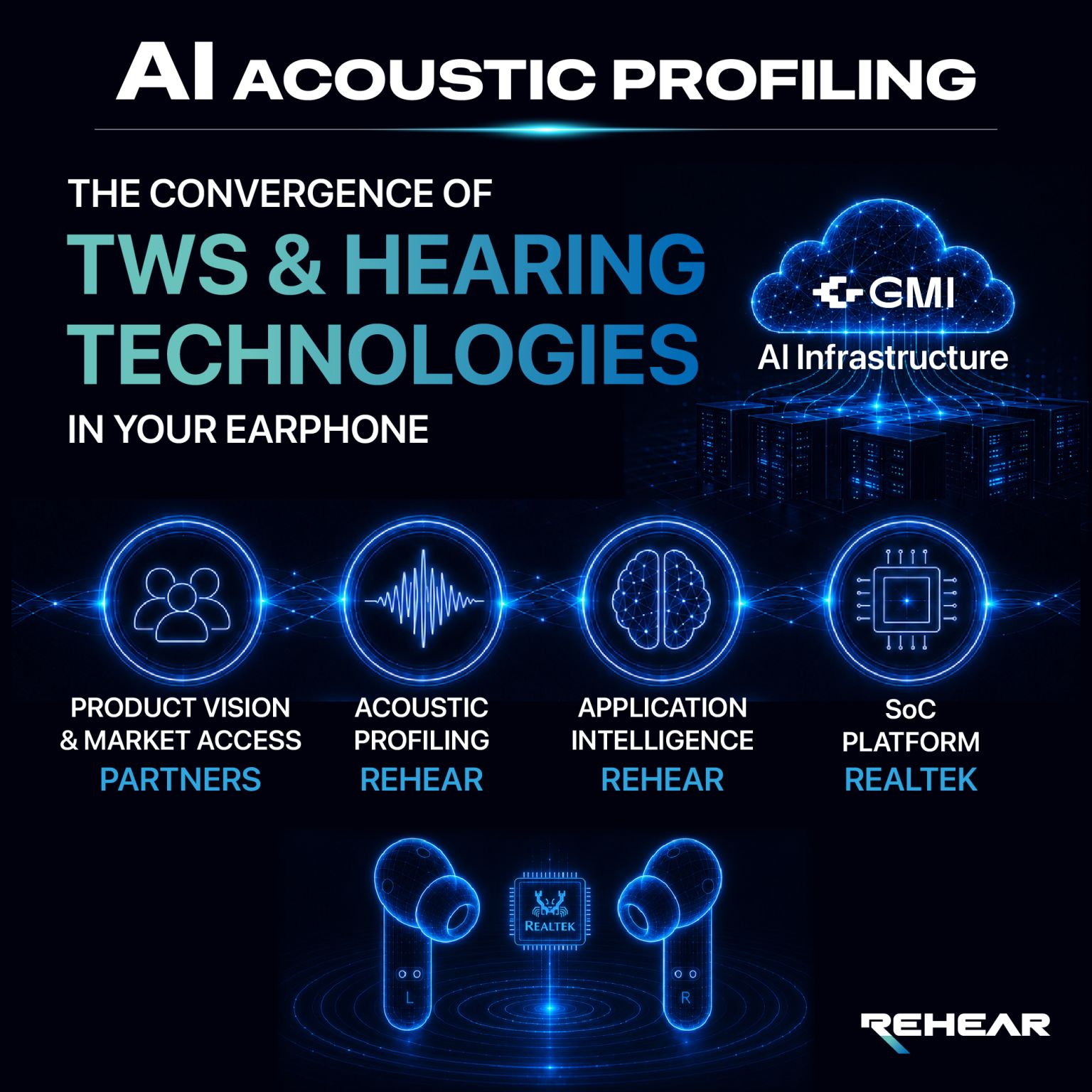
As a partner in NVIDIA's AI cloud ecosystem, GMI Cloud specializes in high-performance, real-time AI inference and GPU cloud computing services. Through this collaboration, GMI Cloud's AI infrastructure is integrated with Rehear Audiology's proprietary AI hearing models and personalized hearing intelligence system layer, developed through the company's expertise in acoustic sensing and audio tuning technologies. The collaboration demonstrates the potential of integrating AI infrastructure with vertical applications to unlock new use cases for conventional Bluetooth earphones.
Shifting from Device Features to System Capabilities: AI Redefines the Hearing Experience
As TWS Bluetooth earphones increasingly incorporate hearing assistance, audio personalization, and health-related features, the global audio industry is evolving from traditional hardware competition toward AI-driven adaptive hearing systems.
Rehear Audiology notes that the value of AI in audio is no longer limited to individual functions such as noise cancellation or speech recognition. Its greater potential lies in building a personalized hearing intelligence system layer that enables sensing, computing, and applications to work together seamlessly. Through feedback based on real-world usage scenarios and personalized parameters, AI hearing models and service capabilities can be continuously optimized while maintaining compliance and safety.
The personalized hearing applications and system-layer architecture showcased by Rehear Audiology at COMPUTEX integrate Bluetooth chips, acoustic sensing, audio tuning, and cloud-based AI hearing models. This enables continuous, cross-device and cross-scenario hearing optimization while advancing product commercialization and clinical validation in compliance with information security and medical regulations.
Moving from Feature Competition to User Trust: Advancing Personalized Hearing Services
While most AI audio solutions focus on device-level specs—such as active noise cancellation (ANC) depth or real-time multilingual translation—Rehear Audiology’s showcase centers on empowering users to monitor their hearing, hear clearly, and protect their auditory health anytime, anywhere through personalized hearing intelligence.
Rehear Audiology stated that its personalized hearing intelligence system layer and cloud platform have passed cybersecurity testing and are currently undergoing hearing aid (HA) clinical validation in Australia following the U.S. FDA regulatory pathway. The company aims to become an end-to-end Software as a Medical Device (SaMD) solution provider, helping clients lower technical and regulatory barriers when entering international markets. Furthermore, the first TWS Bluetooth hearing aid product adopting this technology—and slated for Class I medical device registration with Taiwan’s TFDA—is scheduled to launch in Taiwan by the end of this year.
Advancing AI-as-a-Service Architecture to Build a Personalized Hearing Intelligence Platform
As hearing health concerns increasingly extend to younger demographics and drive demand for personalized everyday hearing assistance, market research projects sustained global growth for TWS Bluetooth earphones over the next decade, with a significant rise in the share of mid-to-high-end models featuring hearing assistance capabilities.
Chia-Wen Yeh, Chairman of Rehear Audiology, stated: "The next step for AI in the audio sector is not just about more powerful computing and models, but how effectively we integrate AI infrastructure and hearing models with real-world usage needs to create trustworthy, continuously evolving personalized hearing services. Rehear Audiology’s AI-as-a-Service (AIaaS) personalized hearing intelligence system layer will progressively redefine the industry boundaries currently set by existing products and services."